Primary Work on Democracy
Dr. Fuller has written three volumes explicitly devoted to the practice of democracy. These works stand in thematic relation to each other, but can also be read as stand-alone pieces.
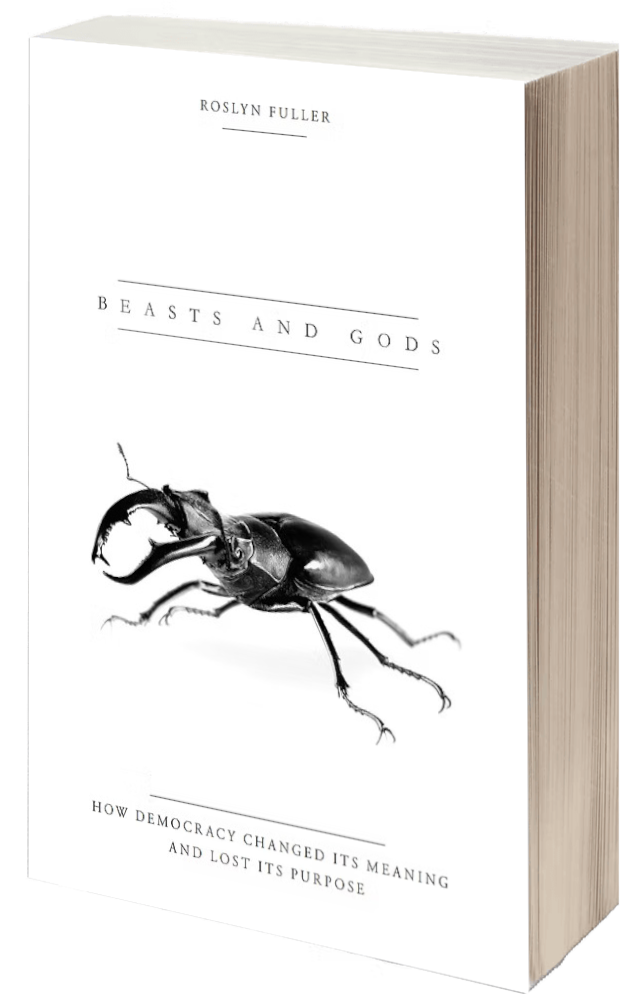
Beasts and Gods: How Democracy
Changed Its Meaning and Lost Its Purpose
Available at
Amazon UK, Amazon US
or at Bloomsbury
Beasts and Gods analyzes the structural flaws that facilitate elite capture of the electoral-representative system. It differentiates itself from the work of others, in that it is a non-partisan systemic analysis.
In this work, Dr. Fuller argues that the accountability chain of government has become so attenuated that it has become impossible for voters to control policy. Unless a mechanism is introduced to reassert that control, the Western world will deepen its cycle of the rich becoming richer and the poor becoming poorer until democracy erodes to the point where the pretense of majority rule is formally dropped.
The work is notable not only for its clear explanations of complex issues, but also for the fact that at the time research for this work commenced (2006) the idea that there was something wrong with the way democracy was practiced was regarded as extremely idiosyncratic. Despite some of the events foreseen in Beasts and Gods having since come to pass, it remains highly relevant as a manual to understanding the issues with present-day democracy and how to fix them.
Its content spans an in-depth analysis of how elections work across multiple voting systems, how national governments interact with the international legal system (including the United Nations, International Monetary Fund, and European Union), as well as a historical overview of the development of modern government, including ancient Greece, Republican Rome and the development of modern State architecture with a particular focus on the Federalist and Anti-Federalist perspectives in the early United States. The book also examines the role of the mass media in modern democracy (for which there is no historical precedent), as well as criticisms of direct democracy, including direct democracy in ancient Athens.
Shortlisted for the Eric Hoffer Grand Prize in 2021.
Other themes: First-Past-the-Post Voting; Proportional Voting; Mixed Member Proportional Voting; Single Transferable Vote; Voting in Ancient Rome; Ancient Lotteries; Cleroterion; Petition; Protest; World Trade Organization; EU Roundtable of Industrialists; Intellectual Property; Lobbying; TRIPS; Trial of Socrates; Solonian Reforms; Rule of the Thirty Tyrants; the Gracchi; Tax Evasion; Inheritance; Vote Buying; Packing, Cracking and other forms of Gerrymandering; IMF Structural Adjustment Loans; Conditionality; Power-Purchasing Agreements; Neoliberalism; Participatory Budgeting; Digital Democracy; Media Concentration; Rule of Law
‘Beasts and Gods provides a fascinating contrast between democracy in theory and democracy in practice. It deconstructs the assumptions underlying representative democracy, and debunks the fiction that modern elections are “free and fair.”'
Marjorie Cohn, Thomas Jefferson School of Law
‘This is the inside story of the slow death of democracy – a loss of power for ordinary people which is occurring almost without comment and, even more worrying, without real protest.’
Nick Davies, The Guardian
'A timely and provocative look behind the cliches of Western politics'
Fintan O'Toole, deputy editor, Irish Times
'Fuller takes the much-needed leap from pointing out what's wrong with our democracies to proposing a parallel system based on democracy's original foundations'
Pia Mancini, co-founder of DemocracyOS
In Defence of Democracy

Following the 2016 Brexit referendum and US Presidential election of Donald Trump, Dr. Fuller was asked to write a polemic engaging with numerous, highly celebrated academic arguments against democracy as a form of government.
The resulting work confronts, among others, arguments put forward by:
Jason Brennan, Georgetown University (Against Democracy)
Ilya Somin, George Mason University (Democracy and Political Ignorance)
Bryan Caplan, George Mason University (The Myth of the Rational Voter: Why Democracies Choose Bad Policies)
Daniel A. Bell, University of Hong Kong (The China Model: Political Meritocracy and the Limits of Democracy)
Christopher Achen and Larry Bartels, Princeton University and Vanderbilt University (Democracy for Realists: Why Elections do Not Produce Responsive Government)
Jonathan Rauch and Benjamin Wittes, Brookings Institute (‘More Professionalism, Less Populism: How Voting Makes us Stupid and What to do About it’)
David van Reybrouck (Against Elections: The Case for Democracy)
In Defence of Democracy examines these arguments, exposing several flaws both in logic and method, and analyzes the systems proposed by these authors to replace democracy, including epistocracy; bureaucratic intervention; Chinese meritocracy; sortition; ‘foot voting’; and party cartelization.
Despite rejecting these practices, which were designed with the specific intention of cutting people out of political decision-making, Dr. Fuller recognizes that there are issues in the way ‘democracy’ is practiced today. The final part of the book is thus devoted to a description of how technology could be used to overcome these issues without disenfranchising the population. Uniquely at the time, the book warned that the unstructured nature of social media, which provides no mechanism via which to resolve arguments, would be its undoing as a political medium, and made recommendations as to how this could be rectified while maintaining freedom.
In Defence of Democracy was a Finalist in the People’s Book Prize and the Next Generation Indie Book Awards.
An Italian translation is available through Edizioni Ariele.
Other themes: Bernie Sanders; Proposition 13; Property Tax; Immigration; Enlightened Preferences; Rational Ignorance; Athenian Democracy; Social Media; Pay-for-Participation; Isegoria; Parrhesia; Informal Leadership; Limited Use-Cases for Sortition; Corruption; Surveillance; UKIP.
‘In Defence of Democracy offers us a preview of what democracy is about to become: much more representative, more direct, more digital, more local and transnational. A winning concept described by this winning writer. Get it! Read it!’
Bruno Kaufmann, Democracy International
‘In an era when, remarkably, the merits of democracy seem to be up for debate, it is invaluable to have so many of the arguments of the anti-democrats dispelled so comprehensively. If you’ve ever felt like you needed the arguments to defend the ability of the people to govern themselves, you’ll find what you need here.’
Robin McAlpine, Director of CommonWeal
Principles of Digital Democracy:
Theory and Case Studies

Available at
Amazon UK, Amazon US
or at de Gruyter
This book was written as part of the ‘Democracy in Times of Upheaval’ series brought out by academic publisher de Gruyter.
Dr. Fuller devoted this book to concretizing concepts from her previous work as an aid for practitioners using digital applications to involve people in democracy. One of the chief aims in this endeavour was to counteract the tendency to use such applications purely for ‘engagement’ and superficial forms of ‘participation’, and to encourage their use as a meaningful form of democracy instead. The book is based on ten years of Dr. Fuller’s work analyzing instances of digital democracy around the world, as well as her interviews with participants and administrators.
In it, Dr. Fuller offers comprehensive guides, including: a thorough explanation of the principles underpinning democracy with heuristics for ensuring processes remain democratic; an analysis of voting security for both online and offline voting; a guide to structuring information for a decision-making process; and an analysis of online abuse, why it is so often misunderstood and how to structure online democracy to maximize freedom.
In addition, she critiques several practices detrimental to democracy, including online democracy, such as: the conflation of democracy with social justice; the effects of impact investing; and the drive for the creation of parallel political spheres.
Other key topics addressed: Vote Coercion; Mass Migration; Participatory Budgeting; Carbon Budgeting; Liquid Democracy; Quadratic Voting; Granny Harvesting; Deliberative Theory; Agonistic Theory; Demographic Analyses of Participation; Stealth Democracy; Dark Triad; Digital Vote Tabulation (Kenya and Brazil); Aadhaar (India); Online Consultation
Online Applications that Feature in the Book: Citizens’ Foundation; Delib; Ethelo; Common Ground for Action; Decidim; Estonian National Voting System; Rousseau; various in-house systems developed e.g. in Paris, Finland, Brazil.
‘You can read Principles of Digital Democracy both as a contemporary history of democracy or as a flight manual. Regardless, I think Fuller’s book will become a modern classic in democracy theory.’
Peer Norbäck, founder of Demoex (2000)
‘In a field dominated by superficiality, Principles of Digital Democracy never fails to dig deeply into why we practice democracy the way we do. As comfortable with Rousseau and elections systems, as with mix-nets and blockchain, Fuller is the rare author who truly understands both tech and politics. Her insights are invaluable for anyone seeking to implement digital democracy today.’
Adam Bennet, CEO, Red Piranha, Cybersecurity
Supplementary Work on Democracy
In addition to the books, Dr. Fuller has also written two supplemental pieces that directly concern democracy: a pamphlet and an in-depth report.

Liberty in an Age of Narcissism
This pamphlet was part of the Letters in Liberty series, published by the Academy of Ideas. This short work distills several important ideas from classical philosophy, modern psychiatry, and the recent rise of the pseudo-religious quest for ‘goodness’. Dr. Fuller’s chief argument is that Western societies are increasingly infantilizing their own populations and that this, rather than any particular convictions, lies behind the push for authoritarianism. Thus, we cannot think or argue this problem away, we can only act it away by re-introducing accountability.
Citizens’ Assemblies: A Critical Appraisal
An in-depth report based on Dr. Fuller’s original research into the citizens' assembly movement (also known as sortition).
Based on this research, Dr. Fuller testified before two parliamentary committees regarding the democratic (and in some cases, legal and constitutional) issues with citizens’ assemblies.
The Report includes:
An examination of the connection between citizens’ assemblies and deliberative democracy
A look at how the citizens’ assembly movement more closely resembles an astro-turf network than a grassroots movement
An exposé of the flawed statistics underlying the alleged representativity of citizens’ assemblies
As assessment of the impact of citizens’ assemblies on Irish politics (including the highly publicized 2018 referendum on abortion)
The manner in which the citizens’ assembly movement misunderstands ancient Athenian democracy in an effort to make the case for citizens’ assemblies as a historic practice
A brief overview of the legal and constitutional issues posed by citizens’ assemblies
An in-depth look at the internal workings of some assemblies, such as the 2023 Irish Assembly on Biodiversity Loss
Also available in German here.
Other themes: climate assemblies; KNOCA; Deliberative Democracy; DemocracyNext; Brand New Bundestag; OECD; European Climate Foundation; Random Selection; Fianna Fail; Fine Gael; Sinn Fein; Macron; Irish Referendum on Social Care; Irish Referendum on the Family; Polarization; Euthanasia; Ekklesia; Boule; Nomothetai; Political Party Regulation; Wisdom of the Crowd
In addition, for nearly a decade, Dr. Fuller was the Managing Director of the Solonian Democracy Institute, where one of her chief activities lay in creating a rubric used to analyze digital democracy tools, across various areas including their functionality, security and democratic potential. An archive of that work, as well as interviews she conducted with various technologists, academics and government representatives, can be viewed here.
Biehler on International Law:
An Irish Perspective

Available at
Wildy & Sons
Following the untimely passing of Prof. Dr. Gernot Biehler (Trinity College Dublin, formerly of the German Diplomatic Service), Dr. Fuller renewed this textbook for publication as a second edition. The work is unique in that it tackles International Law from the perspective of Ireland - a small, and not very powerful nation with a unique history within Europe. The book thus stands in counterpoint to a literature that tends to be produced and dominated by larger powers.
This work looks at various topics, such as Sovereignty, Statehood and Territory, Human Rights and Humanitarian Law, and the Relationship between International and National Law from both a standard international and an Irish perspective. In addition, it contains special sections on topics of particular importance to Ireland, such as Neutrality, Ireland’s History of Peacekeeping and approach to the Use of Force, and the Law of the Sea. Finally, there are chapters on the law of State Responsibility and (an area Prof. Biehler held particular expertise on) Procedure at International Institutions.
Mastering international law is an essential tool for any small, sometimes idiosyncratic nation like Ireland, as it holds the keys to successfully navigating the harsh world of power politics without being utterly subsumed by it.
‘highly informative and an accessible and thoroughly enjoyable read’
Richard Hourihan, Law Society Gazette, Jan/Feb 2016